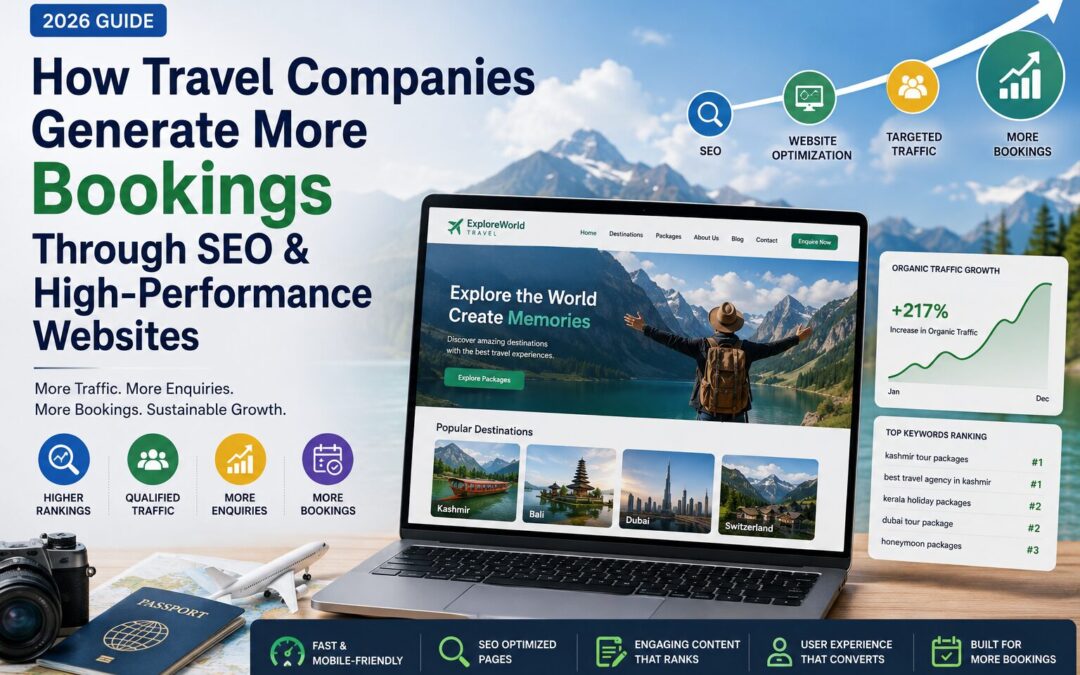
How Travel Companies Generate More Bookings Through SEO and High-Performance Websites (Complete 2026 Guide)
In today’s digital world, a travel company’s success depends on far more than offering attractive tour packages or competitive prices. Before a traveler contacts your agency, compares itineraries, or books a holiday, they almost always start by searching Google.
Whether someone is looking for a Kashmir tour package, a honeymoon in Bali, an adventure trip to Ladakh, or a luxury vacation in Dubai, the first interaction usually happens online. This makes your website one of the most valuable business assets you own.
However, simply having a website isn’t enough.
I’ve seen many travel agencies invest in beautiful website designs only to receive very few enquiries because their websites weren’t optimized for search engines, loaded slowly, or failed to provide the information travelers were looking for.
A high-performance website combined with a well-planned SEO strategy can completely change that.
Instead of relying only on paid advertisements or social media campaigns, travel companies can build a steady flow of organic traffic, attract highly targeted visitors, and convert them into genuine enquiries and confirmed bookings.
In this comprehensive guide, I’ll explain how travel companies can use modern website development, technical SEO, content marketing, and user experience to generate more bookings through Google and other search engines. The strategies shared here are based on real-world experience, practical implementation, and proven SEO principles that continue to work in 2026.
My Experience Building Travel Websites That Generate Business
Over the last few years, I’ve had the privilege of working with travel agencies, tour operators, hotels, and tourism businesses, helping them build websites that do much more than look attractive. My focus has always been on creating websites that are fast, SEO-friendly, user-focused, and capable of generating consistent enquiries.
During my journey as a web developer and SEO specialist, I’ve worked on projects for Astera Tours, Hirfah Holidays, Green Kashmir Travels, Kashmir Holiday Lab, Saffron Travels India, MyKashmirTour, Mazda Tour and Travels, High Rank Tour and Travels, Zarbaf Travels, and many other travel and hospitality brands.
Every project presented unique challenges.
Some businesses wanted to improve their Google rankings. Others were looking to generate more enquiries without increasing their advertising budget. Some needed a complete website redesign because their existing website wasn’t converting visitors into customers despite receiving traffic.
One lesson has remained consistent across every project:
A beautiful website without SEO rarely generates consistent business.
Likewise, SEO alone isn’t enough if visitors land on a slow, outdated, or confusing website.
The most successful travel businesses combine three essential elements:
- A fast and reliable website
- A well-planned SEO strategy
- Helpful content that answers travelers’ questions
I’ve personally seen how improvements such as better website speed, optimized destination pages, proper keyword targeting, improved internal linking, mobile responsiveness, and structured content can significantly increase user engagement and enquiry rates.
These experiences have shaped the strategies I’m sharing throughout this guide. Everything you’ll read is based on practical implementation, continuous testing, and real client work, not just theory.
If you’re a travel agency owner, tour operator, or tourism business looking to grow online, these are the same principles I recommend and implement for every travel website I develop.
Why SEO and High-Performance Websites Matter for Travel Companies
The travel industry is one of the most competitive industries online.
Every day, thousands of travelers search Google for destinations, hotels, holiday packages, transportation, visa information, trekking routes, honeymoon packages, and travel guides.
When your website appears on the first page of search results, you’re not simply receiving visitors; you are reaching people who are actively planning a trip and are much more likely to become customers.
A well-optimized travel website works for your business around the clock by:
- Attracting qualified visitors through Google Search
- Building trust with professional design and valuable content
- Generating enquiries through contact forms and WhatsApp
- Increasing direct bookings
- Reducing dependence on paid advertising
- Strengthening your brand’s online presence
Think of your website as your digital salesperson. It never sleeps; it answers customer questions through your content, showcases your services, and encourages visitors to take the next step.
When combined with SEO, your website becomes one of the most effective long-term marketing investments your business can make.
What You’ll Learn in This Guide
Throughout this guide, you’ll discover:
- How SEO helps travel companies attract qualified visitors.
- Why website speed directly impacts enquiries and bookings.
- The essential features every modern travel website should include.
- How destination-specific content improves Google rankings.
- Ways to increase trust and conversions through better user experience.
- The importance of technical SEO, Core Web Vitals, and mobile optimization.
- Strategies for converting website visitors into paying customers.
- How AI-powered search is changing the future of travel SEO.
Whether you’re launching a new travel website or improving an existing one, the goal is the same: create a website that ranks well, delivers an exceptional experience, and consistently generates business.
The following sections will walk you through each step in detail, using practical strategies that I’ve successfully applied across multiple travel website projects.
Frequently Asked Questions
Yes, absolutely. In my experience, SEO is one of the most effective long-term investments a travel company can make. Unlike paid advertising, where traffic stops as soon as your budget runs out, SEO helps your website attract visitors consistently over time. When your travel website ranks for relevant keywords like destination guides, tour packages, and travel services, you’re reaching people who are already planning a trip and are more likely to become customers.
SEO isn’t an overnight solution. Depending on your website’s current condition, competition, and content quality, you may start seeing improvements within three to six months. More competitive destinations and keywords often take longer, but the results are usually more sustainable than relying only on paid advertising.
This is something I’ve seen quite often. A beautiful design alone doesn’t guarantee business. If your website isn’t ranking on Google, loads slowly, has poor user experience, or doesn’t answer the questions travelers are searching for, visitors may leave without contacting you. A successful travel website combines attractive design, SEO, fast performance, and clear calls to action.
Yes. Social media is an excellent marketing channel, but you don’t own those platforms. Your website is your digital business headquarters. It allows you to control your content, improve your search rankings, collect enquiries, accept bookings, and build long-term authority for your travel brand.
A well-structured travel website should include a homepage, destination pages, tour package pages, an About Us page, contact information, customer testimonials, a travel blog, frequently asked questions, and booking or enquiry forms. These pages help both users and search engines understand your business.
Website speed directly affects user experience. If a website takes too long to load, many visitors leave before exploring your tour packages. A fast, mobile-friendly website keeps visitors engaged, improves Google rankings, and increases the chances that they’ll submit an enquiry or complete a booking.
Definitely. Publishing helpful travel guides, destination articles, itinerary suggestions, visa information, seasonal travel tips, and local experiences can attract thousands of visitors through Google. These visitors often become future customers because your content answers their questions before they’re ready to book.
The right platform depends on your business goals. For most travel agencies and tour operators, WordPress offers excellent flexibility, SEO capabilities, and scalability. If your business requires advanced booking systems or custom functionality, a tailored solution may be the better choice.
One of the most common mistakes is creating only package pages and expecting them to rank. Travelers search for much more than tour packages. They look for destination guides, travel tips, itineraries, weather information, local attractions, and budget advice. Creating useful content around these topics helps attract visitors much earlier in their decision-making process.
While reviews aren’t a direct ranking factor for every search result, they build trust, improve local visibility, and encourage more people to choose your business. Positive reviews also increase click-through rates because travelers naturally prefer companies with strong reputations.
AI is transforming how people discover information, but it hasn’t replaced SEO. In fact, AI-powered search experiences often rely on high-quality, trustworthy websites when generating answers. Travel companies that publish original content, demonstrate real expertise, and maintain technically strong websites are more likely to be referenced by AI platforms.
Your website should never remain static. Review tour packages, pricing, destination information, blog articles, and images regularly. Search engines tend to favor websites that remain accurate, helpful, and up to date. Even small improvements every month can make a noticeable difference over time.
Start with a website audit. Check your loading speed, mobile usability, technical SEO, content quality, internal linking, and user experience. Once you identify the biggest issues, prioritize the changes that will have the greatest impact on visibility and conversions. Improving the foundations first often delivers better long-term results than chasing quick fixes.
Absolutely. Travelers continue to use search engines to research destinations, compare packages, and find trusted travel agencies. A well-optimized website remains one of the most reliable ways to attract qualified visitors, build credibility, and generate bookings without depending entirely on paid advertising.
One lesson stands out above everything else: successful travel websites don’t just focus on design; they focus on helping travelers. The websites that perform best are fast, informative, easy to navigate, and answer real questions before asking visitors to book. That’s the approach I follow whenever I build or optimize a travel website, and it’s the same philosophy behind the strategies shared throughout this guide.
Tags: Travel SEO, Travel Website, Travel Website Development, Travel Website Design, Travel Agency SEO, Tour Operator SEO, Travel Marketing, Travel Business, Travel Agency Website, Website Optimization, SEO Strategy, Google Rankings, Organic Traffic, Lead Generation, Website Speed Optimization, Core Web Vitals, Content Marketing, Digital Marketing