Search engine optimisation is changing, but does that mean traditional SEO is becoming outdated? Not really. The real change is happening in how people search, discover businesses, and interact with information online.
A few years ago, most businesses focused on one major objective: getting their websites to rank higher on Google.
They invested in keyword research, backlinks, technical SEO, content optimisation, and website performance. These activities helped businesses attract visitors, generate enquiries, and build an online presence.
But search behaviour is evolving.
Today, people don’t always visit Google, type a few keywords, and click through ten different websites. They also ask detailed questions through AI assistants, explore AI-generated search summaries, and use conversational search experiences to find products, services, and information.
This shift has created a new approach known as AI SEO.
So, what exactly is AI SEO? How is it different from traditional SEO? And more importantly, which approach should businesses follow in 2027?
In this guide, I’ll explain both approaches, compare their benefits and limitations, discuss the tools worth considering, and share how businesses can prepare their websites for the future of search.
What Is Traditional SEO?
Traditional SEO, or Search Engine Optimization, is the process of improving a website’s visibility in organic search engine results.
The main objective is to help search engines understand your website, discover its pages, and show relevant content to people searching for related information.
For example, imagine someone owns a restaurant in Srinagar and wants more customers to discover it online.
They might target searches such as:
Best restaurant in Srinagar.
Restaurants near Dal Lake.
Best family restaurant in Kashmir.
Restaurant with online food ordering in Srinagar.
A traditional SEO strategy would focus on optimising the restaurant’s website and online presence for these relevant searches.
This could include keyword research, local SEO, Google Business Profile optimisation, technical improvements, quality content, relevant backlinks, and website performance.
Main Components of Traditional SEO
1. Keyword Research
Finding relevant search terms that your potential customers use when looking for your products or services.
2. On-Page SEO
Optimising page titles, meta descriptions, headings, content, images, URLs, and internal links.
3. Technical SEO
Improving website crawling, indexing, mobile usability, page performance, structured data, and overall technical health.
4. Off-Page SEO
Building website authority through relevant backlinks, digital PR, brand mentions, and genuine industry relationships.
5. Content Marketing
Publishing useful articles, guides, landing pages, and resources that answer customer questions.
6. Local SEO
Helping businesses become more visible in location-based searches through relevant local information and business profiles.
Traditional SEO remains an important foundation for organic search visibility.
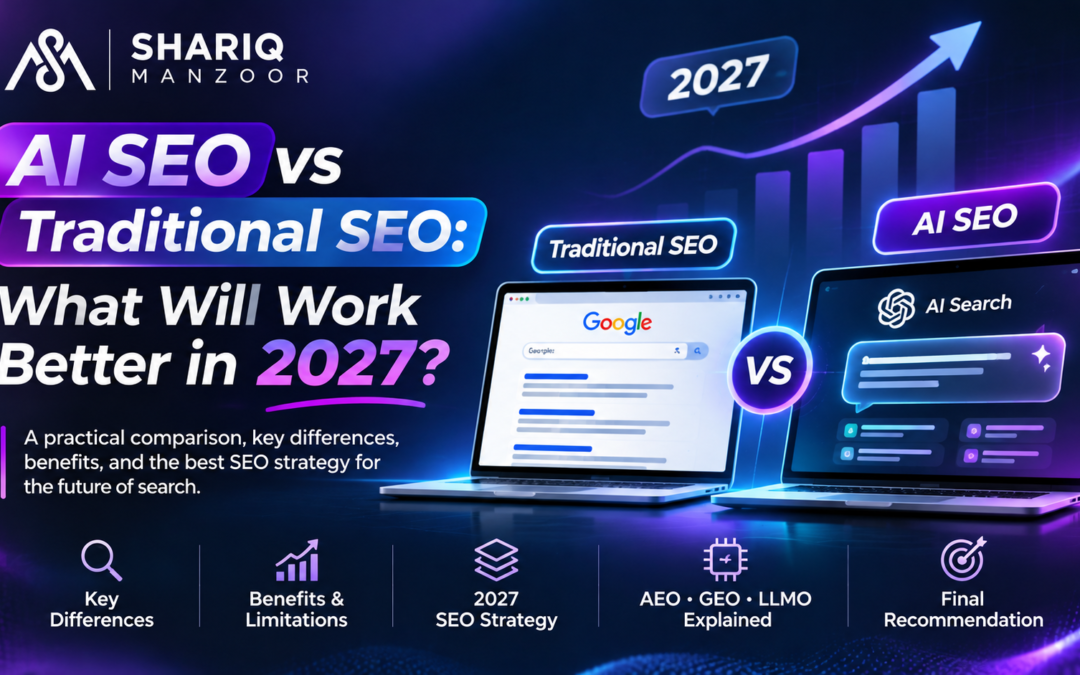
AI SEO vs traditional SEO comparison showing the future of search in 2027
What Is AI SEO?
AI SEO refers to using artificial intelligence, machine learning, automation, and AI-assisted workflows to improve how a website is researched, optimised, understood, and discovered across search experiences.
It can also refer to optimising content and brand information for AI-powered search platforms and conversational discovery systems.
For example, someone might ask an AI assistant:
“Which web development company should I hire to build an eCommerce website for my business in Dubai?”
Instead of simply displaying a list of ten blue links, an AI-powered system may provide a conversational answer, compare options, and reference relevant websites.
This changes the discovery experience.
Businesses now need to think about more than individual keyword rankings. They should also build useful content, establish genuine expertise, maintain consistent business information, and make their websites technically accessible to search systems.
AI SEO can involve:
AI-assisted keyword research.
Search intent analysis.
Competitor research.
Automated technical SEO monitoring.
Content research and optimisation.
Conversational search optimisation.
Answer Engine Optimization (AEO).
Generative Engine Optimization (GEO).
Large Language Model Optimization (LLMO).
AI-assisted reporting and performance analysis.
One important distinction: using AI to improve SEO workflows and optimising for AI-powered search are related, but they are not exactly the same thing.
Both can be part of a modern SEO strategy.
AI SEO vs Traditional SEO: Key Differences
Let’s compare the two approaches.
Comparison
Traditional SEO
AI SEO
Main focus
Organic search visibility
Search visibility across traditional and AI-powered experiences
Keyword research
Manual and tool-assisted
AI-assisted research and clustering
Content creation
Human-led content production
AI-assisted research and human-reviewed content
Search intent
Keyword and audience analysis
Deeper conversational query analysis
Competitor research
Manual and platform-based analysis
AI-assisted competitive insights
Technical SEO
Audits and manual implementation
Automated monitoring and assisted recommendations
Content optimisation
On-page SEO improvements
On-page and AI-assisted content analysis
Search discovery
Search engine results pages
Search engines and AI-powered discovery experiences
Reporting
Traditional SEO reports
AI-assisted analysis and reporting
Human involvement
Strategy and execution
Strategy, verification, oversight, and expertise
The biggest difference isn’t that one replaces the other.
It’s that AI expands the number of ways businesses can research, manage, and improve their SEO activities.
Which Is Better in 2027: AI SEO or Traditional SEO?
My answer is simple: a combination of both is the strongest approach for most businesses.
Traditional SEO provides the foundation. AI SEO adds new capabilities, helps automate repetitive activities, and prepares businesses for changing search experiences.
Think about it this way.
You can have the most advanced AI tools available, but if your website has poor technical SEO, unhelpful content, weak internal linking, or indexing problems, those tools won’t magically fix your online visibility.
Similarly, having a technically perfect website doesn’t mean you should ignore how people are discovering information through AI-powered search.
A successful 2027 strategy should combine:
Strong technical SEO.
Relevant keyword and search intent research.
Original and helpful content.
Genuine authority and brand credibility.
AI-assisted research and automation.
Content that answers real customer questions.
Measurement across traditional and emerging search experiences.
The objective is not to choose between two approaches. It is to build a better search strategy using the strengths of both.
7 Major Ways AI Is Changing SEO in 2027
Let’s look at the areas where AI is creating new opportunities for SEO professionals and businesses.
1. Search Is Becoming More Conversational
Traditional keyword searches are often short.
For example:
“Website developer Dubai”
But people increasingly use detailed questions:
“Who can build a professional WordPress website for my small business in Dubai, and how much will it cost?”
This means your content strategy should address complete questions and customer needs rather than simply targeting short keywords.
Businesses should create useful resources around:
Customer problems.
Product comparisons.
Pricing questions.
Buying decisions.
Technical explanations.
Service-related questions.
AI-assisted research can help discover these questions and organise them into useful content topics.
2. AI-Powered Search Experiences Are Changing Discovery
AI-powered search experiences can summarise information, connect related topics, and provide links to supporting websites.
Google’s AI Overviews and AI Mode are examples of this changing search experience.
This doesn’t mean traditional search results have disappeared.
Instead, users may interact with summaries and explore supporting sources in different ways.
For businesses, the opportunity is to create relevant, trustworthy information that deserves to be discovered and referenced.
Your website still needs to be accessible, indexable, useful, and technically sound.
3. Content Quality Matters More Than Content Quantity
Earlier, many SEO strategies focused heavily on publishing content consistently and targeting more keywords.
In 2027, businesses should be more careful about what they publish.
AI makes it easier to produce large amounts of content, but publishing more articles doesn’t automatically create more organic visibility.
A useful article should provide something meaningful:
Original insights.
Practical examples.
Accurate explanations.
Real industry knowledge.
Relevant supporting information.
Clear answers to customer questions.
For example, instead of publishing another generic article about website development, a web developer could write about the actual challenges involved in building a booking website for a hotel in Kashmir.
That article can demonstrate practical knowledge that a generic AI-generated article may not provide.
This is where human expertise becomes valuable.
4. AEO Is Becoming an Important Part of Content Strategy
Answer Engine Optimization (AEO) focuses on making content useful for systems that provide direct answers to user questions.
Consider this question:
“What is the difference between AI SEO and traditional SEO?”
A well-structured article should answer this question clearly before exploring the topic in greater detail.
AEO-friendly content should include:
Direct answers.
Descriptive headings.
Clear explanations.
Relevant examples.
Accurate definitions.
Useful comparisons.
Natural question-based sections.
However, AEO isn’t about adding hundreds of questions to every page.
It’s about understanding what your audience wants to know and answering those questions properly.
5. GEO Is Expanding the Way Businesses Think About Visibility
Generative Engine Optimization (GEO) is a developing approach focused on improving how a brand’s information can be discovered and referenced in generative AI experiences.
For example, someone might ask an AI assistant:
“Recommend a reliable web developer in Kashmir for building an eCommerce website.”
A business wants its services and expertise to be discoverable when relevant questions are asked.
To support that objective, businesses should work on:
Detailed and useful service pages.
Original industry resources.
Consistent brand information.
Relevant portfolio projects.
Clear author and business information.
Genuine third-party references.
Accurate and accessible website content.
There is no guaranteed formula that forces an AI platform to recommend a particular business.
GEO should be treated as a long-term visibility strategy, not a shortcut.
6. AI Agents Are Making SEO Workflows More Efficient
One of the biggest practical advantages of AI is automation.
SEO professionals spend considerable time on repetitive tasks such as research, reporting, content audits, competitor analysis, and performance monitoring.
AI agents can help connect these activities into more efficient workflows.
For example, an AI-assisted SEO workflow could:
Identify new keyword opportunities.
Compare them with existing website content.
Analyse competitor coverage.
Prepare a content brief.
Suggest internal linking opportunities.
Review published content.
Monitor performance.
Prepare recommendations.
This can save time and help SEO professionals focus more on strategic work.
However, human review remains necessary before making important technical changes or publishing content.
7. Brand Authority and Trust Remain Important
Search visibility isn’t just about adding keywords to your website.
Businesses need to communicate who they are, what they offer, and why customers should trust them.
This includes:
Clear business and author information.
Genuine customer reviews.
Relevant case studies.
Original portfolio projects.
Accurate service descriptions.
Consistent business details.
Useful industry contributions.
For example, a web development professional should showcase actual websites, explain the technologies used, and demonstrate how their work solves business problems.
These details provide context and help visitors evaluate your expertise.
Traditional SEO Techniques That Will Still Matter in 2027
With all the discussion around AI, some people assume traditional SEO is becoming irrelevant.
I disagree.
Several traditional SEO practices remain essential.
Technical SEO
Your website should be easy to crawl, render, and index.
Important areas include:
XML sitemaps.
Robots.txt configuration.
Canonical URLs.
Mobile usability.
Page speed.
Core Web Vitals.
Redirect management.
Structured data.
Indexing checks.
Quality Backlinks
Relevant backlinks and genuine industry references can support website discovery, authority, and reputation.
Focus on relevant websites, meaningful partnerships, digital PR, and useful resources rather than purchasing large quantities of low-quality links.
On-Page Optimisation
Every important page should have a clear purpose, descriptive title, useful content, logical headings, and relevant internal links.
Local SEO
Local businesses should maintain accurate Google Business Profile information, relevant location pages, genuine reviews, and consistent contact details.
User Experience
A website should be easy to navigate, responsive on mobile devices, accessible, and designed to help visitors complete their goals.
These fundamentals are not becoming less important just because AI is involved in search.
Best AI SEO Tools to Consider in 2027
You don’t need dozens of subscriptions to build an effective AI SEO strategy.
Here are some platforms worth exploring.
1. ChatGPT
Useful for keyword research, content planning, competitor analysis, SEO workflows, content reviews, and technical explanations.
My advice is to choose tools according to your actual requirements. A well-planned workflow using a few reliable platforms is more useful than paying for multiple tools without a clear strategy.
How to Build a Combined AI SEO and Traditional SEO Strategy
If you’re a business owner or SEO professional, here’s a practical approach I recommend.
Step 1: Audit Your Existing Website
Start with your website’s current condition.
Review:
Organic traffic.
Indexing status.
Technical SEO.
Existing keywords.
Top-performing pages.
Backlink profile.
Content quality.
Conversion performance.
You need a baseline before deciding what to improve.
Step 2: Build a Search Intent-Based Keyword Strategy
Identify the keywords and questions your potential customers actually use.
Separate them into categories:
Informational.
Commercial.
Transactional.
Navigational.
Local search intent.
Then map the keywords to relevant pages instead of targeting everything through blog articles.
Step 3: Improve Your Existing Content
Before publishing dozens of new articles, review what you already have.
Update outdated information, improve weak explanations, add original examples, fix internal links, and remove unnecessary repetition.
Step 4: Introduce AI-Assisted SEO Automation
Start with repetitive activities.
For example:
Weekly competitor monitoring.
Keyword opportunity research.
Content gap analysis.
Technical issue reporting.
SEO performance summaries.
Keep human approval for important decisions.
Step 5: Improve AEO and GEO Readiness
Make your website easier to understand.
Use clear headings, useful explanations, accurate business information, original examples, and relevant supporting content.
Build a consistent digital presence around your expertise.
Step 6: Monitor More Than Keyword Rankings
Track both traditional and emerging search visibility.
Important metrics include:
Organic clicks.
Search impressions.
Relevant keyword positions.
Organic conversions.
Qualified enquiries.
Content engagement.
AI search mentions and citations where measurable.
The goal is to measure business growth, not just the number of keywords appearing in a report.
A Practical 2027 SEO Strategy for Different Businesses
Not every business needs the same SEO strategy.
Here are some examples.
For Local Businesses
A restaurant, hotel, salon, or service provider should prioritise:
Local SEO.
Google Business Profile.
Location-specific landing pages.
Customer reviews.
Accurate business information.
Helpful FAQs.
Mobile-friendly website design.
AI-assisted tools can support content research, review analysis, and reporting.
For eCommerce Businesses
Online stores should prioritise:
Product page optimisation.
Category page content.
Product descriptions.
Product structured data.
Website performance.
Image optimisation.
Customer reviews.
Product discovery and conversion tracking.
AI can help organise product information and identify content opportunities, but product accuracy is essential.
For Service-Based Businesses
Agencies, consultants, freelancers, and professional service providers should focus on:
Service-specific landing pages.
Case studies.
Portfolio projects.
Industry guides.
Pricing explanations.
Customer questions.
Relevant brand mentions.
Lead generation.
Demonstrating actual experience can make a service website more useful than publishing generic keyword-focused articles.
Common AI SEO Mistakes Businesses Should Avoid
AI can improve productivity, but using it incorrectly can create problems.
Here are mistakes I would avoid in 2027.
1. Replacing all human content with AI
AI can help with research and writing, but your website should include original knowledge, accurate information, and real expertise.
2. Publishing hundreds of AI-generated pages
Large-scale production of unoriginal content without meaningful value can violate Google’s scaled content abuse policies.
3. Ignoring traditional SEO
AI tools cannot compensate for crawling problems, indexing errors, poor website structure, or irrelevant content.
4. Chasing every trending AI SEO technique
Not every new GEO or LLMO tactic is effective. Avoid spending resources on unverified tricks or artificial brand mentions.
5. Measuring success only through rankings
Rankings are useful, but qualified visitors, enquiries, leads, and sales are more meaningful business outcomes.
6. Forgetting the user
The purpose of SEO is to connect people with useful information and relevant businesses. Never sacrifice the user experience for automation.
Frequently Asked Questions (FAQs)
1. What is the difference between AI SEO and traditional SEO?
Traditional SEO focuses on improving organic search visibility through keyword research, technical SEO, content optimisation, backlinks, and other established practices. AI SEO uses artificial intelligence and automation to improve SEO workflows and support visibility across AI-powered search experiences.
2. Will AI SEO replace traditional SEO in 2027?
No. Traditional SEO remains the foundation of organic search visibility. AI SEO expands how businesses research, optimise, automate, and approach emerging search experiences. Combining both is a sensible long-term strategy.
3. Is AI SEO better than traditional SEO?
Neither approach is universally better. Traditional SEO provides essential technical and content foundations, while AI SEO offers additional research, automation, and analysis capabilities. The right combination depends on your website and business goals.
4. Can AI SEO improve Google rankings?
AI-assisted SEO can help identify opportunities, improve content planning, and support technical optimisation. However, using AI does not guarantee higher Google rankings. Results depend on relevance, quality, competition, technical health, and many other factors.
5. What is AEO in SEO?
Answer Engine Optimization focuses on creating content that clearly answers user questions and is useful for answer-focused search experiences and systems.
6. What is GEO in digital marketing?
Generative Engine Optimization is an emerging approach focused on improving the discoverability and representation of brands and their information in generative AI-powered search experiences.
7. What is LLMO?
Large Language Model Optimization refers to efforts to make a brand’s information, expertise, and content easier for large language models to understand and associate with relevant topics. It is an evolving term rather than a formally standardised ranking discipline.
8. Does Google support AI-generated content?
Google does not automatically penalise content simply because AI was used to create it. Its guidance focuses on content quality, accuracy, originality, and usefulness. Using automation to generate large amounts of unoriginal content primarily to manipulate rankings can violate its spam policies.
9. Which AI SEO tools should beginners use?
Beginners can start with Google Search Console, Google Analytics, ChatGPT, and an SEO research platform such as Semrush or Ahrefs. Additional automation tools can be introduced when there is a clear need.
10. How do I optimise my website for AI search in 2027?
Start with strong technical SEO, useful original content, clear website structure, accurate business information, relevant internal links, and genuine expertise. Monitor your visibility in both traditional search and supported AI search experiences.
11. Will backlinks still matter in 2027?
Relevant backlinks and genuine third-party references remain useful parts of a broader SEO and digital reputation strategy. Focus on quality and relevance rather than artificial link-building schemes.
12. How long does it take to see results from an AI SEO strategy?
There is no guaranteed timeline. Workflow improvements may happen quickly, but organic search growth depends on competition, content quality, website authority, technical implementation, and how search systems evaluate your pages.
Final Thoughts: The Future of SEO Is Not AI vs Traditional SEO
After looking at both approaches, my conclusion is that businesses shouldn’t treat AI SEO and traditional SEO as competing strategies.
They work better together.
Traditional SEO helps build the foundation of a website through technical improvements, relevant content, search intent, and authority.
AI SEO helps businesses research faster, automate repetitive activities, understand changing search behaviour, and prepare for AI-powered discovery experiences.
But the fundamentals haven’t disappeared.
People still need accurate information. Businesses still need trust. Websites still need good technical foundations. And content still needs to provide genuine value.
If I were building an SEO strategy for a business in 2027, I wouldn’t abandon traditional SEO to chase AI trends. I would strengthen the fundamentals and use AI wherever it creates a meaningful advantage.
The businesses that succeed won’t necessarily be the ones using the most AI tools. They’ll be the ones that understand their customers, create better experiences, and use technology intelligently.
I’m Shariq Manzoor, a web developer and digital professional focused on website development, SEO, and modern digital experiences.
I believe a successful website should do more than simply look good. It should be technically sound, useful to visitors, and built with long-term search visibility in mind.
SEO is changing. And businesses that learn how to work with AI agents today could have a significant advantage in 2027.
For years, SEO has involved a lot of manual work. Keyword research, competitor analysis, content planning, technical audits, backlink analysis, performance tracking, and reporting all require time and consistent effort.
But things are changing.
AI is no longer just a tool for generating blog posts or suggesting keywords. We are entering a phase where AI agents can research information, analyse data, identify opportunities, execute specific tasks, and help businesses make smarter marketing decisions.
Imagine having an intelligent system that monitors your website, identifies technical SEO problems, studies your competitors, finds content gaps, suggests new keyword opportunities, and prepares actionable recommendations while you focus on growing your business.
That’s where AI agents come in.
As we move towards 2027, I believe businesses should stop thinking about SEO as a collection of repetitive tasks and start building smarter, AI-assisted SEO systems.
The goal isn’t simply to use more AI tools. It’s to achieve better results with less wasted effort.
In this guide, I’ll explain how AI agents can transform SEO workflows, which tasks they can handle, how to combine AI with human expertise, and how to build a practical SEO strategy for 2027.
What Are AI Agents in SEO?
AI agents are intelligent systems designed to work towards specific goals by analysing information, making decisions, and performing tasks with varying levels of independence.
Unlike traditional AI tools that generally wait for instructions and generate a response, AI agents can follow a workflow, use connected tools, evaluate results, and decide what action to take next within their assigned permissions.
In SEO, this means an AI agent can be assigned a particular responsibility, such as:
Researching keyword opportunities.
Analysing competitors and their content strategies.
Identifying missing topics on your website.
Monitoring website performance.
Detecting technical SEO issues.
Preparing content briefs and optimisation recommendations.
Tracking keyword movements and reporting changes.
For example, instead of manually checking competitors every week, you could build an AI-assisted workflow that collects competitor information, compares their content with yours, identifies missing topics, and prepares a prioritised action plan.
However, an important distinction is worth understanding: not every AI-powered SEO tool is an AI agent. Some tools simply generate recommendations, while agentic systems can carry out multiple connected steps towards a defined objective.
Human review is still important, particularly before publishing content, changing website code, or making decisions that could affect organic traffic.
Why 2027 SEO Strategies Need AI Agents
SEO is becoming more complex.
People are discovering businesses through traditional Google searches, AI Overviews, AI-powered search experiences, conversational assistants, and other discovery platforms.
This means businesses need to think beyond ranking individual keywords.
They need to build a digital presence that search engines and AI systems can understand, trust, and connect with relevant user questions.
Here are five reasons why AI agents deserve attention in your 2027 SEO strategy.
AI agents can help collect and organise this information much faster.
Instead of starting every SEO task from scratch, businesses can use AI-assisted research workflows to generate insights and prioritise opportunities.
2. Search behaviour is evolving
Users are asking longer, more conversational questions and expecting useful answers.
A potential customer might search:
Who is the best web developer for small businesses in Dubai?
How much does an eCommerce website cost?
Which SEO strategy works for a local business in 2027?
What should I look for before hiring a web development agency?
Your content strategy needs to address these real questions rather than focusing only on short, high-volume keywords.
3. Content production needs better planning
Publishing more articles doesn’t automatically produce better SEO results.
Businesses need relevant topics, original insights, accurate information, useful internal links, and a clear content structure.
AI agents can help identify opportunities and organise content production without replacing the expertise required to create genuinely valuable material.
4. Technical SEO needs continuous attention
A website can lose organic visibility because of broken links, indexing problems, duplicate pages, slow loading times, or incorrect technical configurations.
AI-assisted monitoring can help identify these problems and bring important issues to your attention before they become bigger problems.
5. Businesses need to work more efficiently
SEO teams often spend too much time on repetitive activities.
By automating research, reporting, monitoring, and selected optimisation tasks, teams can dedicate more time to strategy, creativity, technical improvements, and customer experience.
That’s the real opportunity: improving productivity without compromising quality.
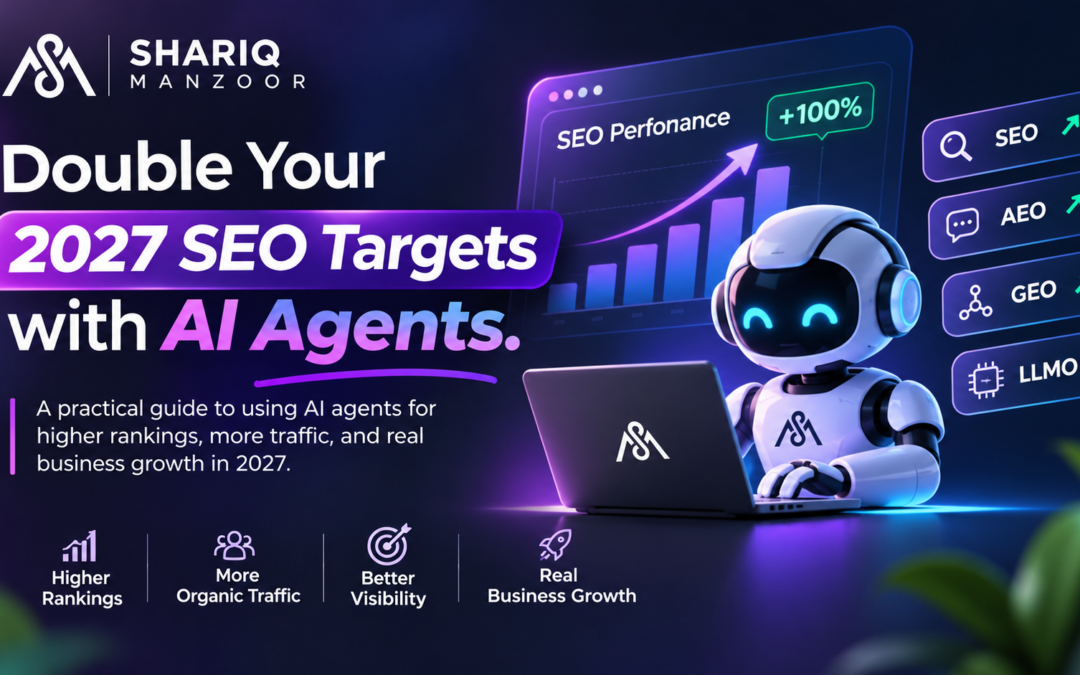
AI agents transforming SEO strategy and digital marketing in 2027
10 Ways AI Agents Can Help You Improve Your SEO Performance in 2027
Let’s look at where AI agents can make a practical difference.
1. AI-Powered Keyword Research
Keyword research is one of the foundations of a successful SEO strategy.
But finding keywords with high search volume isn’t enough. You also need to understand search intent, competition, relevance, and the likelihood of attracting potential customers.
An AI keyword research agent can help:
Discover relevant primary and secondary keywords.
Identify long-tail search opportunities.
Group keywords according to search intent.
Identify commercial and informational queries.
Compare keyword opportunities with competitor websites.
Find missing topics within your existing content.
For example, a web development business targeting Dubai could identify opportunities around:
Website development company in Dubai.
WordPress developer in Dubai.
eCommerce website development Dubai.
Custom website development for small businesses.
Website redesign services in Dubai.
The agent can organise these opportunities into topic clusters and suggest which pages should target each group.
My recommendation: Don’t select keywords based on search volume alone. Prioritise relevance, search intent, competition, and business value.
2. Competitor SEO Analysis
Your competitors can provide useful information about what is working in your industry.
An AI agent can analyse publicly available competitor information and help identify:
Keywords competitors are targeting.
Topics they cover that your website doesn’t.
Their content structure and internal linking.
Their service pages and positioning.
Opportunities to create more useful resources.
Changes in their search visibility.
For example, if three competitors are publishing detailed guides about website development costs but your website has no resource covering this topic, an AI agent can flag that gap.
You can then create a more useful article based on your own knowledge, pricing experience, and understanding of customer requirements.
The objective isn’t to copy competitors. It’s to understand the market and create something better.
3. Automated Content Research and Planning
Content marketing requires consistency, but publishing content without a proper strategy can waste resources.
AI agents can help develop an organised content calendar based on keyword opportunities, customer questions, industry trends, and existing website content.
A content research workflow could:
Collect relevant search queries.
Identify the questions people are asking.
Group related topics.
Check existing website coverage.
Identify content gaps.
Prepare article outlines.
Suggest internal linking opportunities.
Prioritise articles according to business relevance.
For example, a website development agency could build a content cluster around WordPress development.
The cluster might include:
What Is WordPress Website Development?
How Much Does a WordPress Website Cost in 2027?
WordPress vs Shopify: Which Is Better for Your Business?
Common WordPress Website Security Problems.
How to Improve WordPress Website Speed.
How to Choose the Right WordPress Developer.
Each article should answer a different user need and link naturally to relevant service pages.
This approach creates a more useful resource library instead of publishing disconnected blog posts.
4. AI Agents for Technical SEO Audits
Technical SEO is an area where automation can save considerable time.
An AI-assisted technical SEO agent can help review website data and flag problems such as:
Broken internal and external links.
Missing title tags and meta descriptions.
Duplicate or conflicting metadata.
Incorrect canonical tags.
Redirect chains.
Indexing and crawling problems.
Missing image alt attributes.
Structured data validation issues.
Core Web Vitals and page performance concerns.
You can connect selected workflows with tools such as Google Search Console, Google Analytics, crawling software, and website monitoring systems.
For example, an agent could review a weekly technical SEO report, identify pages with indexing problems, and prepare a list of recommended fixes.
However, don’t give an AI agent unrestricted access to modify your website. Review its recommendations before implementing changes to robots.txt, redirects, canonical tags, or important page templates.
5. AI-Assisted On-Page SEO Optimisation
On-page SEO involves making each page relevant, understandable, and useful for its intended audience.
An AI agent can review your existing pages and suggest improvements to:
SEO titles.
Meta descriptions.
Heading structures.
Keyword placement.
Content readability.
Internal links.
Image descriptions.
Content relevance.
Search intent alignment.
Imagine having 100 service and blog pages.
Reviewing every page manually can take a significant amount of time. An AI-assisted workflow can identify pages that need attention and help you prioritise updates.
But don’t rewrite every page just because an AI tool recommends it.
Sometimes your existing content is already performing well. Unnecessary changes can introduce problems rather than improve performance.
Focus on pages with clear improvement opportunities.
6. Build Better AEO Strategies with AI Agents
Answer Engine Optimization (AEO) focuses on making your content useful and understandable for systems that provide direct answers to user questions.
Think about how people search today.
Instead of typing only “website developer”, someone might ask:
“How do I choose a reliable website developer for my small business?”
Your content should address these questions directly.
AI agents can help identify relevant questions and structure content around them.
A strong AEO strategy includes:
Clear answers to important questions.
Descriptive headings.
Helpful explanations.
Relevant examples.
Accurate information.
Supporting evidence.
Consistent terminology.
Useful FAQ sections where appropriate.
For example:
Question: Why does a business need a professional website?
A professional website helps businesses establish an online presence, showcase their products and services, build customer trust, generate enquiries, and provide customers with information at any time.
This is a straightforward answer that both readers and information retrieval systems can understand.
The important thing is to answer genuine customer questions rather than adding unnecessary FAQs simply to target keywords.
7. Improve GEO and LLMO Visibility
Traditional SEO focuses heavily on visibility in search engine results.
But businesses also want to be discovered when people ask questions through AI-powered platforms and conversational assistants.
This is where Generative Engine Optimization (GEO) and Large Language Model Optimization (LLMO) come into the discussion.
The objective is to make your brand, expertise, services, and information easier for AI systems to discover, understand, and associate with relevant topics.
AI agents can support this process by helping you:
Identify questions customers ask AI assistants.
Develop detailed, fact-based resources.
Maintain consistent brand information.
Identify missing information across your website.
Monitor brand mentions across supported platforms.
Analyse how your business is described in AI-generated responses.
Build stronger connections between your services and relevant topics.
For example, if you provide web development services, your website should clearly explain what you develop, which technologies you use, who you serve, what problems you solve, and how customers can contact you.
Your service pages, portfolio, case studies, author information, and supporting articles should reinforce the same genuine expertise.
Remember, there is no guaranteed technique that makes an AI assistant recommend your business. Visibility depends on many factors, including information quality, relevance, availability, and the systems used by each platform.
8. Smarter Internal Linking Opportunities
Internal links help visitors and search engines discover related information across your website.
However, as websites grow, identifying the best linking opportunities becomes increasingly difficult.
An AI agent can analyse your existing content and suggest relevant connections between:
Blog articles.
Service pages.
Portfolio projects.
Industry guides.
Related resources.
For example, an article about WordPress website speed could naturally link to your WordPress development service and a related website performance guide.
This improves navigation and helps search engines understand how different pages relate to one another.
The final links should always be contextually relevant. Avoid adding internal links just to increase their number.
9. Automated SEO Monitoring and Reporting
SEO doesn’t end when you publish an article or optimise a page.
You need to monitor performance and understand what is changing.
An AI reporting agent can help analyse information from Google Search Console, Google Analytics, and other connected tools.
It can prepare reports covering:
Organic clicks and impressions.
Search queries.
Average search positions.
Pages gaining or losing traffic.
Changes in conversions.
Indexing issues.
Content performance.
Opportunities for improvement.
For example, if an important service page receives impressions but very few clicks, the agent could flag the page for a title and meta description review.
If an article receives organic traffic but generates no enquiries, you may need to improve its calls to action or connection to your services.
The important part is understanding what the numbers mean and taking appropriate action.
10. AI Agents for SEO Strategy and Decision-Making
Perhaps the biggest opportunity is bringing different SEO activities together.
Instead of using separate tools for keyword research, competitor analysis, content planning, technical audits, and reporting, you can create connected workflows that share information.
For example:
A keyword research workflow identifies a valuable topic.
A competitor analysis workflow checks existing coverage.
A content planning workflow prepares an outline.
A content review workflow checks relevance, originality, and accuracy.
A technical workflow checks whether the published page is accessible and indexable.
A monitoring workflow tracks its performance.
This creates a more connected SEO process.
However, the final strategy should remain under human control. AI agents can provide information and recommendations, but business priorities, editorial decisions, and high-impact technical changes need appropriate human oversight.
Best AI Tools to Consider for Your 2027 SEO Strategy
AI agents are not limited to one platform. You can build a workflow using different AI assistants, SEO platforms, analytics tools, and automation systems.
Here are some tools worth exploring.
1. ChatGPT
ChatGPT can help with SEO research, content planning, keyword clustering, competitor analysis, technical explanations, and workflow design.
With suitable connected tools and permissions, it can also support more complex, multi-step research and execution workflows.
My recommendation: Don’t subscribe to every available AI platform. Start with the tools you already use, identify repetitive SEO activities, and automate those first.
A Practical AI Agent SEO Workflow for 2027
Let’s understand how all these activities can work together.
Imagine you manage a website development agency and want to increase organic traffic and qualified enquiries.
You could build the following workflow.
Stage
AI agent responsibility
Expected output
Research
Identify keyword opportunities
Keyword list
Analysis
Study competitors
Competitor insights
Planning
Find content gaps
Content calendar
Creation
Prepare content briefs
Article outlines
Optimisation
Review on-page SEO
Improvement suggestions
Technical SEO
Identify website issues
Technical audit
Publishing
Assist with content workflow
Reviewed content
Monitoring
Track search performance
SEO reports
Improvement
Identify underperforming pages
Action plan
The workflow becomes even more useful when different agents can share information.
For example, the content planning agent can use information from competitor research, while the optimisation agent can use the content brief and existing website structure.
You don’t need to build all these agents immediately.
Start with one useful workflow, measure its results, and expand gradually.
The 90-Day Roadmap to Prepare Your SEO Strategy for 2027
If you want to use AI agents effectively, I recommend following a structured implementation plan.
Days 1–30: Build Your SEO Foundation
Start by understanding your website’s current performance.
Your first priorities should be:
Connect and review Google Search Console.
Analyse existing organic traffic.
Identify your best-performing pages.
Review technical SEO problems.
Research your main competitors.
Identify important keyword opportunities.
Organise your website’s existing content.
At this stage, your objective is to understand where your website currently stands.
Don’t automate a process you haven’t properly understood.
Days 31–60: Introduce AI-Assisted Workflows
Once you have a clear picture of your website, start introducing AI agents into repetitive tasks.
Focus on:
Automated keyword research.
Competitor content monitoring.
Content gap analysis.
SEO content brief generation.
On-page SEO reviews.
Technical issue reporting.
Internal linking suggestions.
Make sure you review the results before allowing agents to publish content or make significant website changes.
Days 61–90: Measure, Improve, and Scale
Now focus on performance.
Analyse:
Organic traffic growth.
Keyword visibility.
Search impressions and clicks.
Qualified website enquiries.
Content performance.
Technical SEO improvements.
Time saved through automation.
Identify which workflows are producing useful results and which need improvement.
Then expand the successful workflows to other pages, services, and marketing activities.
The objective is to build a repeatable SEO system rather than depend on random automation.
How to Measure Whether AI Agents Are Actually Improving Your SEO
One mistake businesses make is measuring AI adoption instead of business performance.
Using ten AI tools doesn’t mean your SEO strategy is successful.
You need to measure the actual impact.
Here are the metrics I recommend tracking.
SEO metric
What to measure
Organic traffic
Growth in relevant organic visits
Search visibility
Impressions and keyword performance
Organic clicks
Visitors coming from search
Conversions
Enquiries, calls, leads, and sales
Content productivity
Time required to research and publish
Technical SEO
Errors identified and resolved
AI search visibility
Relevant brand mentions and citations where measurable
SEO efficiency
Time and resources saved
One particularly important metric is qualified organic leads.
Getting 10,000 visitors who never become customers may be less valuable than getting 1,000 visitors who are genuinely interested in your services.
Always connect SEO performance with business outcomes.
Common Mistakes to Avoid When Using AI Agents for SEO
AI automation can create opportunities, but using it incorrectly can also damage your website’s quality and credibility.
Here are some mistakes businesses should avoid.
1. Publishing AI-generated content without reviewing it
AI-generated information can contain inaccuracies, outdated facts, and repetitive explanations. Every important article should be checked for originality, accuracy, and usefulness.
2. Automating everything without a strategy
Automation should support your SEO strategy, not replace it. First decide what needs to improve, then identify which tasks can be automated.
3. Creating hundreds of low-quality articles
Publishing large amounts of repetitive content simply to target more keywords is not a sustainable SEO strategy. Google’s spam policies address scaled content abuse, including content generated primarily to manipulate search rankings.
4. Ignoring technical SEO
Even excellent content needs to be accessible, crawlable, and indexable. AI content workflows cannot compensate for a poorly maintained website.
5. Depending entirely on AI recommendations
AI agents can misunderstand search intent, overlook important context, and make incorrect recommendations. Human expertise and verification remain necessary.
6. Chasing AI search visibility instead of customer value
Don’t create content simply because you want an AI assistant to mention your business. Create resources that genuinely help your audience understand problems and make better decisions.
So, Can AI Agents Really Double Your 2027 SEO Targets?
Let’s answer this honestly.
Yes, AI agents can help businesses work towards significantly higher SEO targets, but doubling results is not guaranteed.
The outcome depends on your website’s current performance, industry competition, technical foundation, content quality, available resources, and how effectively you implement automation.
For example, imagine your website currently publishes four quality articles each month.
With better research, structured workflows, and AI-assisted content preparation, your team might be able to publish eight equally useful articles without doubling the time spent on the process.
That’s an improvement in productivity.
Similarly, an automated reporting system might help identify technical issues earlier, while competitor analysis workflows could help you discover opportunities that would otherwise be missed.
But remember:
More content doesn’t automatically mean more traffic. More keywords don’t automatically mean more customers. And more AI tools don’t automatically mean better SEO.
The real objective is to combine automation, expertise, creativity, and continuous improvement.
That’s how businesses can build a stronger foundation for 2027 and beyond.
My Final Thoughts: The Future of SEO Is Human Expertise Combined with AI Agents
I believe the next phase of SEO will be less about performing every task manually and more about building intelligent systems that help businesses make better decisions.
AI agents can take care of repetitive research, organise information, monitor performance, and support optimisation workflows.
But they cannot replace the importance of understanding your customers, knowing your industry, creating original insights, and building genuine trust.
If you’re a business owner, marketer, SEO professional, or website developer, now is a good time to understand how these systems work.
Start small. Automate repetitive activities. Monitor the results. Improve your workflows. And always keep your audience at the centre of your strategy.
At the end of the day, successful SEO isn’t about publishing more content or using more tools.
It’s about helping the right people discover your business, understand what you offer, and trust you enough to take the next step.
Want to build a website and SEO strategy that’s ready for 2027?
I’m Shariq Manzoor, a web developer and digital professional working on website development, search engine optimisation, and modern digital experiences. I help businesses build websites that are technically sound, user-friendly, and designed with long-term online visibility in mind.
AI agents in SEO are intelligent systems that can research, analyse, monitor, and perform specific SEO tasks through connected tools and workflows. They help automate repetitive activities and support better SEO decision-making.
2. How can AI agents improve SEO rankings in 2027?
AI agents can help identify keyword opportunities, analyse competitors, improve content planning, monitor technical SEO, and track website performance. These activities can support better SEO results, but rankings are never guaranteed.
3. Can AI agents replace SEO professionals?
No. AI agents can automate selected tasks, but SEO professionals are still needed for strategy, technical decisions, content quality, search intent analysis, and understanding business goals.
4. What is the difference between AI tools and AI agents in SEO?
Traditional AI tools generally perform specific tasks when prompted, such as generating keywords or writing content. AI agents can work through multiple connected steps, use tools, evaluate results, and take permitted actions towards a defined objective.
5. Is AI-generated content good for SEO?
AI-assisted content can be useful when it is accurate, original, relevant, and genuinely helpful. Content should be reviewed by people who understand the subject. Publishing large quantities of low-value AI-generated content can violate Google’s spam policies.
6. What is the role of AI agents in AEO and GEO?
AI agents can help identify conversational questions, organise useful answers, improve content structure, and monitor brand visibility across supported AI-powered discovery platforms. They support AEO and GEO strategies, but cannot guarantee inclusion in AI-generated answers.
7. Which AI tools are best for SEO automation?
ChatGPT, Semrush, Ahrefs, Make, and n8n are useful options for different SEO research and automation workflows. Google Search Console is also essential for monitoring organic search performance.
8. How do I start using AI agents for my website’s SEO?
Begin with a website audit and keyword research. Identify repetitive tasks such as competitor monitoring, reporting, and content gap analysis. Automate one workflow at a time, review its output, and measure the results before expanding.
9. Will traditional SEO still matter in 2027?
Yes. Technical SEO, helpful content, crawlability, indexing, relevant internal links, and a good user experience remain important foundations for organic search visibility, including Google’s AI-powered search experiences.
10. How long does it take to see SEO results from AI automation?
There is no fixed timeline. Some efficiency improvements, such as faster reporting and issue identification, may become visible quickly. Improvements in organic rankings, traffic, and leads depend on competition, website quality, implementation, and search engine evaluation.
In today’s digital world, a travel company’s success depends on far more than offering attractive tour packages or competitive prices. Before a traveler contacts your agency, compares itineraries, or books a holiday, they almost always start by searching Google.
Whether someone is looking for a Kashmir tour package, a honeymoon in Bali, an adventure trip to Ladakh, or a luxury vacation in Dubai, the first interaction usually happens online. This makes your website one of the most valuable business assets you own.
However, simply having a website isn’t enough.
I’ve seen many travel agencies invest in beautiful website designs only to receive very few enquiries because their websites weren’t optimized for search engines, loaded slowly, or failed to provide the information travelers were looking for.
A high-performance website combined with a well-planned SEO strategy can completely change that.
Instead of relying only on paid advertisements or social media campaigns, travel companies can build a steady flow of organic traffic, attract highly targeted visitors, and convert them into genuine enquiries and confirmed bookings.
In this comprehensive guide, I’ll explain how travel companies can use modern website development, technical SEO, content marketing, and user experience to generate more bookings through Google and other search engines. The strategies shared here are based on real-world experience, practical implementation, and proven SEO principles that continue to work in 2026.
My Experience Building Travel Websites That Generate Business
Over the last few years, I’ve had the privilege of working with travel agencies, tour operators, hotels, and tourism businesses, helping them build websites that do much more than look attractive. My focus has always been on creating websites that are fast, SEO-friendly, user-focused, and capable of generating consistent enquiries.
During my journey as a web developer and SEO specialist, I’ve worked on projects for Astera Tours, Hirfah Holidays, Green Kashmir Travels, Kashmir Holiday Lab, Saffron Travels India, MyKashmirTour, Mazda Tour and Travels, High Rank Tour and Travels, Zarbaf Travels, and many other travel and hospitality brands.
Every project presented unique challenges.
Some businesses wanted to improve their Google rankings. Others were looking to generate more enquiries without increasing their advertising budget. Some needed a complete website redesign because their existing website wasn’t converting visitors into customers despite receiving traffic.
One lesson has remained consistent across every project:
A beautiful website without SEO rarely generates consistent business.
Likewise, SEO alone isn’t enough if visitors land on a slow, outdated, or confusing website.
The most successful travel businesses combine three essential elements:
A fast and reliable website
A well-planned SEO strategy
Helpful content that answers travelers’ questions
I’ve personally seen how improvements such as better website speed, optimized destination pages, proper keyword targeting, improved internal linking, mobile responsiveness, and structured content can significantly increase user engagement and enquiry rates.
These experiences have shaped the strategies I’m sharing throughout this guide. Everything you’ll read is based on practical implementation, continuous testing, and real client work, not just theory.
If you’re a travel agency owner, tour operator, or tourism business looking to grow online, these are the same principles I recommend and implement for every travel website I develop.
Why SEO and High-Performance Websites Matter for Travel Companies
The travel industry is one of the most competitive industries online.
Every day, thousands of travelers search Google for destinations, hotels, holiday packages, transportation, visa information, trekking routes, honeymoon packages, and travel guides.
When your website appears on the first page of search results, you’re not simply receiving visitors; you are reaching people who are actively planning a trip and are much more likely to become customers.
A well-optimized travel website works for your business around the clock by:
Attracting qualified visitors through Google Search
Building trust with professional design and valuable content
Generating enquiries through contact forms and WhatsApp
Increasing direct bookings
Reducing dependence on paid advertising
Strengthening your brand’s online presence
Think of your website as your digital salesperson. It never sleeps; it answers customer questions through your content, showcases your services, and encourages visitors to take the next step.
When combined with SEO, your website becomes one of the most effective long-term marketing investments your business can make.
What You’ll Learn in This Guide
Throughout this guide, you’ll discover:
How SEO helps travel companies attract qualified visitors.
Why website speed directly impacts enquiries and bookings.
The essential features every modern travel website should include.
How destination-specific content improves Google rankings.
Ways to increase trust and conversions through better user experience.
The importance of technical SEO, Core Web Vitals, and mobile optimization.
Strategies for converting website visitors into paying customers.
How AI-powered search is changing the future of travel SEO.
Whether you’re launching a new travel website or improving an existing one, the goal is the same: create a website that ranks well, delivers an exceptional experience, and consistently generates business.
The following sections will walk you through each step in detail, using practical strategies that I’ve successfully applied across multiple travel website projects.
Frequently Asked Questions
Does SEO really help travel companies get more bookings?
Yes, absolutely. In my experience, SEO is one of the most effective long-term investments a travel company can make. Unlike paid advertising, where traffic stops as soon as your budget runs out, SEO helps your website attract visitors consistently over time. When your travel website ranks for relevant keywords like destination guides, tour packages, and travel services, you’re reaching people who are already planning a trip and are more likely to become customers.
How long does it take for SEO to start generating results for a travel website?
SEO isn’t an overnight solution. Depending on your website’s current condition, competition, and content quality, you may start seeing improvements within three to six months. More competitive destinations and keywords often take longer, but the results are usually more sustainable than relying only on paid advertising.
Why isn’t my travel website generating enquiries even though it looks professional?
This is something I’ve seen quite often. A beautiful design alone doesn’t guarantee business. If your website isn’t ranking on Google, loads slowly, has poor user experience, or doesn’t answer the questions travelers are searching for, visitors may leave without contacting you. A successful travel website combines attractive design, SEO, fast performance, and clear calls to action.
Is having a website better than relying only on social media?
Yes. Social media is an excellent marketing channel, but you don’t own those platforms. Your website is your digital business headquarters. It allows you to control your content, improve your search rankings, collect enquiries, accept bookings, and build long-term authority for your travel brand.
What are the most important pages every travel website should have?
A well-structured travel website should include a homepage, destination pages, tour package pages, an About Us page, contact information, customer testimonials, a travel blog, frequently asked questions, and booking or enquiry forms. These pages help both users and search engines understand your business.
How does a high-performance website improve bookings?
Website speed directly affects user experience. If a website takes too long to load, many visitors leave before exploring your tour packages. A fast, mobile-friendly website keeps visitors engaged, improves Google rankings, and increases the chances that they’ll submit an enquiry or complete a booking.
Should travel companies invest in blogging?
Definitely. Publishing helpful travel guides, destination articles, itinerary suggestions, visa information, seasonal travel tips, and local experiences can attract thousands of visitors through Google. These visitors often become future customers because your content answers their questions before they’re ready to book.
Which platform is best for building a travel website?
The right platform depends on your business goals. For most travel agencies and tour operators, WordPress offers excellent flexibility, SEO capabilities, and scalability. If your business requires advanced booking systems or custom functionality, a tailored solution may be the better choice.
What is the biggest SEO mistake travel companies make?
One of the most common mistakes is creating only package pages and expecting them to rank. Travelers search for much more than tour packages. They look for destination guides, travel tips, itineraries, weather information, local attractions, and budget advice. Creating useful content around these topics helps attract visitors much earlier in their decision-making process.
Do Google reviews and testimonials help SEO?
While reviews aren’t a direct ranking factor for every search result, they build trust, improve local visibility, and encourage more people to choose your business. Positive reviews also increase click-through rates because travelers naturally prefer companies with strong reputations.
Can AI replace SEO for travel companies?
AI is transforming how people discover information, but it hasn’t replaced SEO. In fact, AI-powered search experiences often rely on high-quality, trustworthy websites when generating answers. Travel companies that publish original content, demonstrate real expertise, and maintain technically strong websites are more likely to be referenced by AI platforms.
How often should I update my travel website?
Your website should never remain static. Review tour packages, pricing, destination information, blog articles, and images regularly. Search engines tend to favor websites that remain accurate, helpful, and up to date. Even small improvements every month can make a noticeable difference over time.
What is the first thing I should improve if my travel website isn’t performing well?
Start with a website audit. Check your loading speed, mobile usability, technical SEO, content quality, internal linking, and user experience. Once you identify the biggest issues, prioritize the changes that will have the greatest impact on visibility and conversions. Improving the foundations first often delivers better long-term results than chasing quick fixes.
Is SEO still worth investing in for travel companies in 2026?
Absolutely. Travelers continue to use search engines to research destinations, compare packages, and find trusted travel agencies. A well-optimized website remains one of the most reliable ways to attract qualified visitors, build credibility, and generate bookings without depending entirely on paid advertising.
What have you learned from working with travel websites?
One lesson stands out above everything else: successful travel websites don’t just focus on design; they focus on helping travelers. The websites that perform best are fast, informative, easy to navigate, and answer real questions before asking visitors to book. That’s the approach I follow whenever I build or optimize a travel website, and it’s the same philosophy behind the strategies shared throughout this guide.
Tags: Travel SEO, Travel Website, Travel Website Development, Travel Website Design, Travel Agency SEO, Tour Operator SEO, Travel Marketing, Travel Business, Travel Agency Website, Website Optimization, SEO Strategy, Google Rankings, Organic Traffic, Lead Generation, Website Speed Optimization, Core Web Vitals, Content Marketing, Digital Marketing
Freelance Web developer, graphic designer & digital Marketer Hard work day to day life
As a freelancer in the web development, graphic design, and digital marketing field, my daily life would likely involve a combination of the following tasks:
Web development: Writing and testing code to create, maintain, and update websites.
Graphic design: Creating visual designs for websites, logos, advertisements, and other marketing materials.
Digital marketing: Planning and executing digital marketing campaigns, including email marketing, social media marketing, and search engine optimization (SEO).
Client communication: Interacting with clients to understand their needs, provide updates on projects, and address any concerns or questions.
Project management: Keeping track of deadlines, and budgets, and ensuring that projects are completed on time and within scope.
Continuing education: Staying up to date with the latest industry trends and advancements in technology, in order to offer the best services to clients.
Overall, a day in the life of a web developer, graphic designer, and digital marketer freelancer would involve a mix of creative, technical, and business tasks, with a focus on delivering high-quality work for clients.
If you’re looking for a reliable and experienced web developer, I would love to hear from you. Let’s work together to bring your online vision to life!
Facebook
Linkedin
Twitter
Pinterest
Telegram
Whatsapp
Reddit
Request A Free Quote
Office Address:
3rd Floor, Noora Complex, Maisuma, Lal Chowk, Srinagar, Jammu and Kashmir, India - 190001
Content marketing: A straightforward guide to explaining content marketing to a new team member
By Haika Shah
What is content marketing?
Content marketing is a marketing system used to draw in, connect with, and hold a group of people by making and sharing important articles, recordings, webcasts, and different media. This approach lays out skills, advances brand mindfulness, and keeps your business top of the psyche when now is the right time to purchase what you sell.
Definition of content marketing:
Content marketing is a strategic marketing approach focused on creating and distributing valuable, relevant, and consistent content to attract and retain a clearly-defined audience — and, ultimately, to drive profitable customer action.
There are various kinds of content marketing, including:
⦁ Contributing to a blog ⦁ Video ⦁ Podcasting ⦁ Infographics ⦁ Email ⦁ Visual content ⦁ Digital books/eBooks ⦁ Lead magnets ⦁ Whitepapers ⦁ SlideShare introductions/Presentations ⦁ Tests/instruments/Quizzing ⦁ Courses ⦁ Webinars ⦁ Slide decks ⦁ Free applications ⦁ Social media posts and more The key is that the content gives data or amusement, typically for free, on the side of a business objective.
The following are four things that numerous organizations need to escape their content marketing endeavours:
⦁ Directing traffic to the landing page ⦁ Spreading brand mindfulness ⦁ Building connections ⦁ Acquiring income ⦁ Creating social offers and backlinks